A Population, Not a Single Mother
Genetics shows that the ancestors of Native Americans crossed from Beringia as a small founding population—estimated at several hundred to a few thousand individuals—not a single family or lone matriarch.
In evolutionary biology, a "population bottleneck" occurs when a small subset of a larger group breaks away and settles in a new territory, carrying only a fraction of the original group's genetic diversity. The ancestors of Native Americans certainly experienced a pronounced bottleneck as they moved into Beringia and subsequently into the Americas. However, genetic modeling—which measures diversity across millions of base pairs in the nuclear genome—demonstrates that this founding group was a viable, reproducing community consisting of hundreds, and likely a few thousand, men, women, and children. A single woman, or even a single nuclear family, could never have sustained the genetic variation observed across ancient and modern Indigenous genomes.
Multiple Maternal Lineages
To understand where the "one woman" rumor came from, we have to look at mitochondrial DNA (mtDNA). Unlike nuclear DNA—which is a shuffled mosaic inherited equally from both your mother and your father (and all four grandparents, eight great-grandparents, and so on)—mitochondrial DNA sits outside the cell's nucleus in the mitochondria and is passed down strictly from mother to child, largely unchanged except for rare, random mutations over thousands of years.
Because mtDNA does not recombine with paternal DNA, geneticists can trace unbroken maternal family trees backward through deep time. Each major branch on that maternal tree is called a haplogroup.
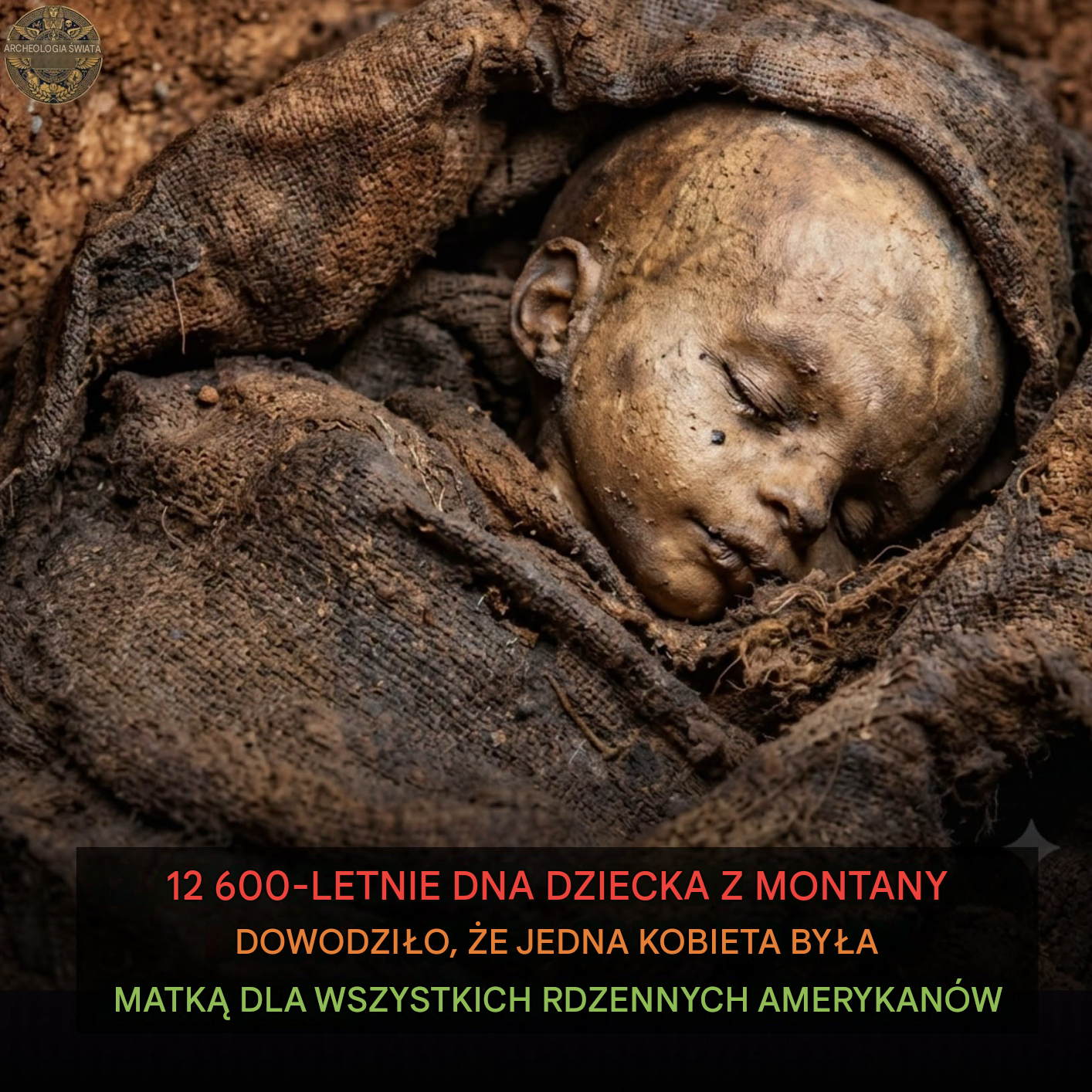
Anzick-1 carried a specific maternal lineage called haplogroup D4h3a.
• Today, D4h3a is rare among modern Native Americans, found primarily in Indigenous populations along the Pacific coast of North and South America—from California down to Chile and Patagonia.
• Finding D4h3a in an inland Montana child who lived 12,600 years ago provided a crucial clue about early migration routes, suggesting that early coastal migrants and inland Clovis groups were closely connected.
However, D4h3a is just one maternal lineage among many. Geneticists have established that living Native Americans descend from at least five major founding maternal haplogroups—designated A2, B2, C1, D1, and X2a—alongside rarer founding branches like D4h3a (and sub-branches like C4c).
Each of these distinct haplogroups represents a separate ancestral maternal line that entered the Americas during the initial peopling of the continent. That means multiple ancestral women, belonging to distinct maternal lineages, contributed to the Native American gene pool. Even if you trace back tens of thousands of years earlier to Asia, these lineages had already diverged from one another long before anyone crossed Beringia.
Please click on the next page to continue reading 👇