Step 3: Coastal Highway vs. Ice-Free Corridor
How did Anzick-1’s ancestors get past the two-mile-thick wall of ice covering Canada?
For decades, archaeologists assumed they walked down an Ice-Free Corridor that opened up between the Cordilleran and Laurentide ice sheets in modern-day Alberta and British Columbia. However, geological and ancient DNA studies of lake sediments along that corridor showed that it did not become biologically viable—with plants, animals, and passable terrain—until around 12,600 years ago, after people were already living in Chile, Florida, and Montana.
Consequently, most archaeologists and geneticists now favor the Pacific Coastal Route (often called the "Kelp Highway"). Starting around 16,000 to 17,000 years ago, early migrants likely traveled south along the unglaciated coastline of Alaska and British Columbia using watercraft, subsisting on rich marine resources—kelp forests, fish, seals, shellfish, and seabirds—before moving inland along major river systems like the Columbia River into the interior of North America.
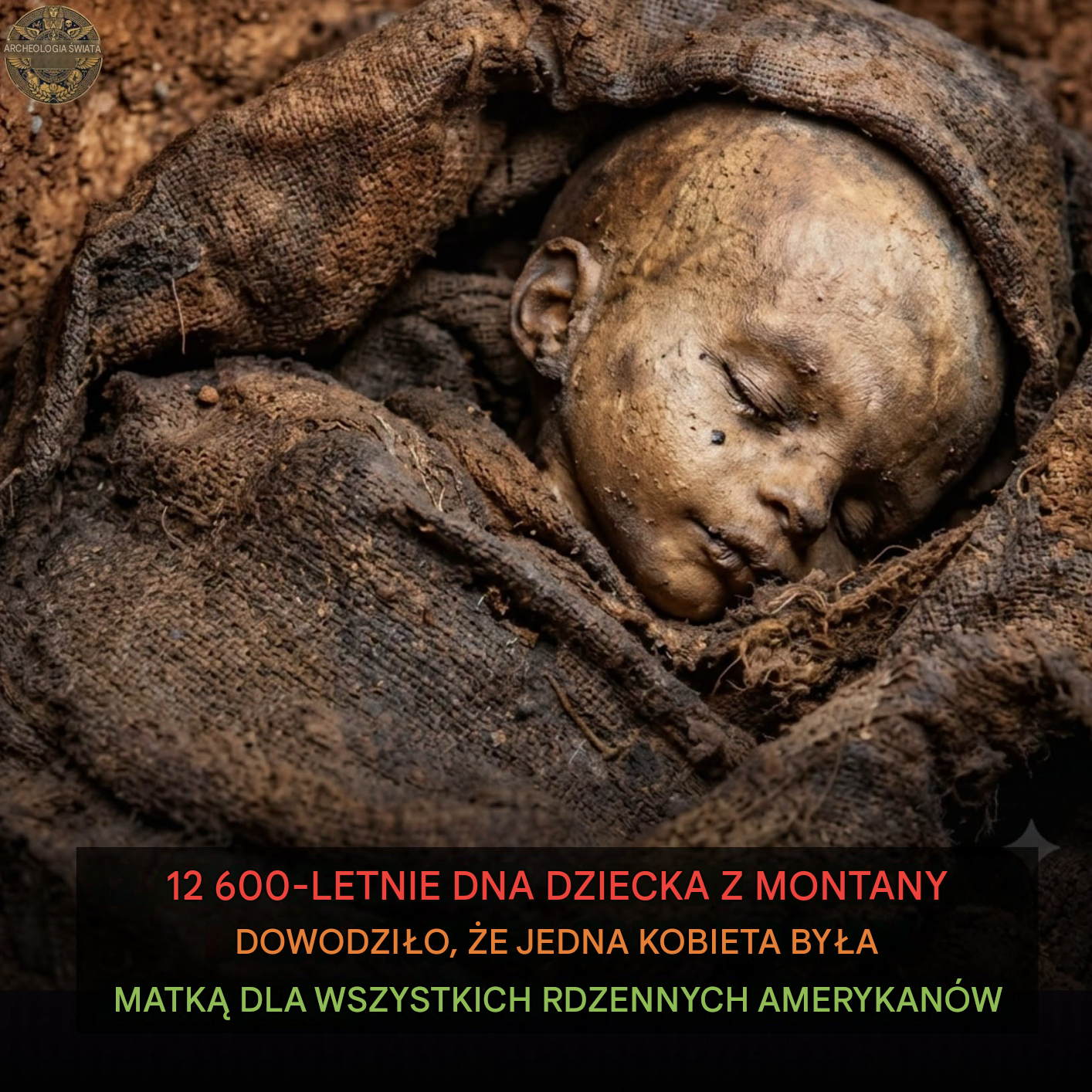
Anzick-1’s mitochondrial DNA—haplogroup D4h3a—strongly supports this coastal connection. Because D4h3a is distributed almost exclusively down the Pacific rim from Alaska to southern Chile, its presence in a 12,600-year-old Clovis child in Montana demonstrates how early coastal populations moved inland into the Rocky Mountains and Great Plains, carrying their ancestral lineages with them as the Clovis cultural tradition emerged.
How Anzick-1 Connects to Other Famous Ancient Genomes
Anzick-1 does not stand alone. His genome forms the anchor point for a growing constellation of ancient American genomes that confirm the same overarching narrative:
• Kennewick Man (The Ancient One): Found along the Columbia River in Washington State and dating to roughly 8,500 years ago, his skull shape initially led some anthropologists to claim he was unrelated to modern Native Americans. In 2015, Eske Willerslev’s team sequenced his genome and proved he was closely related to modern Native Americans—specifically the Colville Tribes of the Pacific Northwest—and belonged to the Northern branch that split from Anzick-1’s lineage thousands of years earlier.
• Spirit Cave Mummy: Recovered in Nevada and dating to roughly 10,600 years ago, genome sequencing in 2018 showed that this individual was much closer genetically to Anzick-1 and modern Native Americans—particularly Indigenous peoples of South America—than to any non-American population.
• Lagoa Santa, Brazil: Ancient genomes from 10,000-year-old remains in Brazil—which also had skull shapes once thought to suggest an "Australo-Melanesian" migration—proved to be directly descended from the exact same Southern Native American lineage as Anzick-1.
In every single case, whole-genome sequencing overturned old theories based on skull measurements and confirmed that a single primary founding population gave rise to the Indigenous peoples of both continents.
Please click on the next page to continue reading 👇